EN
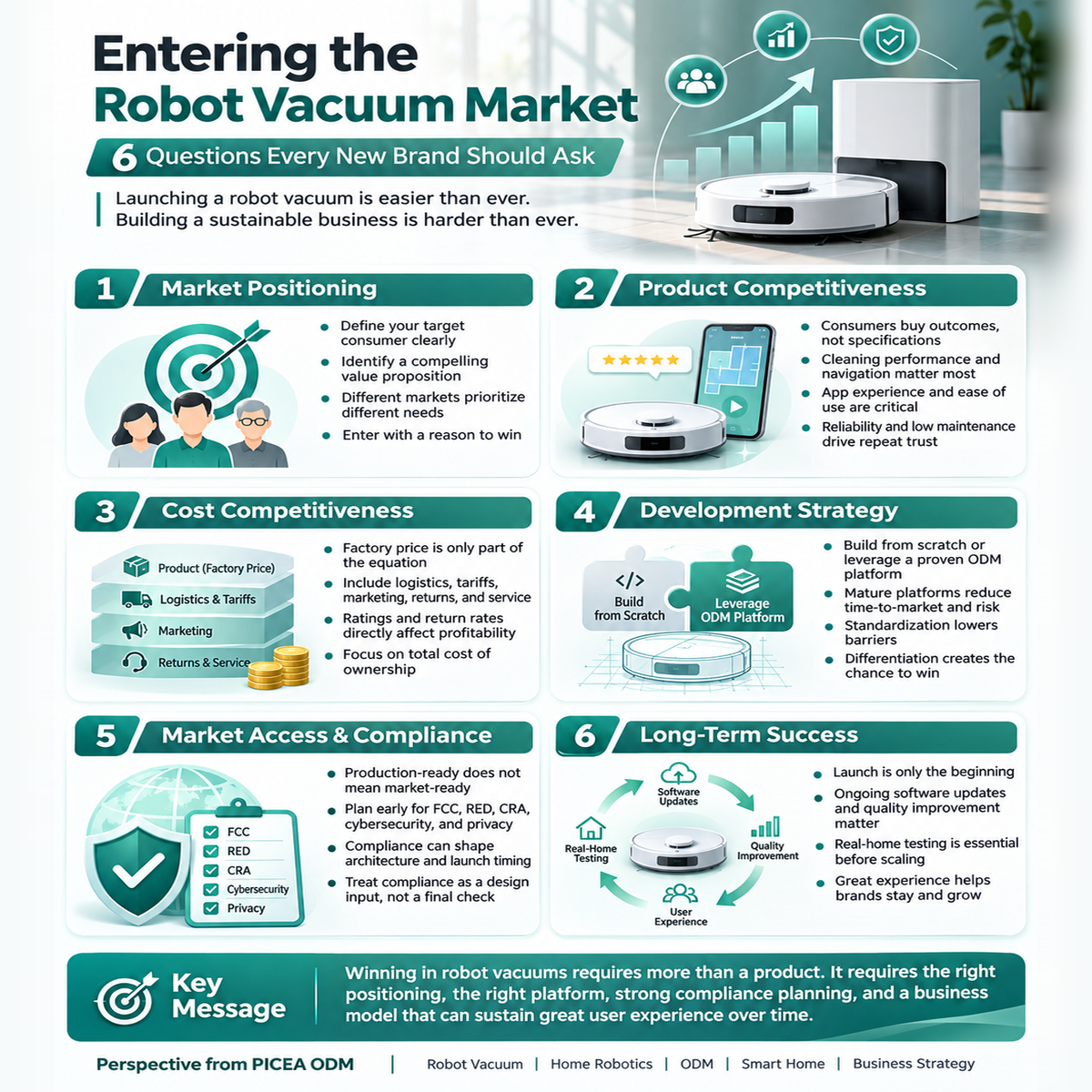
Entering the Robot Vacuum Market: 6 Questions Every New Brand Should Ask
Entering the robot vacuum market is easier than ever. Building a successful and sustainable business in this category is harder than ever.
The global robot vacuum cleaner (RVC) market remains one of the most promising segments in the home appliance industry.
Advances in AI, intelligent navigation, deep cleaning, and automated maintenance are transforming robot vacuums from convenient gadgets into essential household appliances.At the same time, competition is intensifying. Technology evolves rapidly, consumer expectations continue to rise, and leading brands are strengthening their competitive advantages.
For established appliance brands, retailers, and distributors considering entering this category, the opportunity is still significant. But the requirements for success have fundamentally changed.A few years ago, entering the market might have been as simple as sourcing a decent product.Today, success requires much more than a competitive product. It requires a complete business model capable of delivering long-term value to consumers. Based on our experience working with international brands across different markets, I believe there are six critical questions every new entrant should consider.
1. Market Positioning: Why Should Consumers Choose Your Brand?
Before deciding what product to launch, every new entrant should answer a more fundamental question:
Why should consumers choose your brand over established market leaders?
Consumer expectations vary significantly across countries, regions, and market segments.
Some markets are highly price-sensitive. Others place greater emphasis on cleaning performance, intelligent features, convenience, brand reputation, or after-sales service.
A new entrant does not necessarily need to outperform market leaders in every dimension. However, it must identify a clear target audience and establish a compelling value proposition.
Market positioning determines product definition. Product definition shapes the cost structure. Together, they determine whether the business model can succeed.
The goal is not simply to enter the market, but to enter with a clear reason to win.
2. Product Competitiveness: Are You Selling Features or User Experience?
Robot vacuums are highly integrated products, combining hardware, software, algorithms, and increasingly, AI.
Specifications such as suction power, navigation technology, mop systems, and docking station features certainly matter.
But consumers do not buy specifications. They buy outcomes.
What really matters is whether the product delivers on the expectations that matter most to users:
Does it consistently deliver excellent cleaning performance?
Can it navigate reliably without getting stuck or requiring frequent intervention?
Is the app intuitive, stable, and easy to use?
Does it genuinely reduce the need for daily maintenance?
Will the product remain reliable after six months or a year of regular use?
We are seeing a fundamental shift in industry competition.
The battleground is moving from individual hardware specifications to the overall user experience — cleaning performance, intelligence, reliability, and maintenance-free convenience.
For new entrants, prioritizing the experiences consumers value most is often more effective than trying to offer every possible feature.
3. Cost Competitiveness: Do You Understand the True Cost of the Business?
One of the most common mistakes new entrants make is focusing too heavily on the factory purchase price.
In reality, the total cost of a robot vacuum business goes far beyond the product itself.
Logistics, tariffs, distribution margins, marketing expenses, warranty costs, returns, after-sales service, and inventory risks all have a direct impact on profitability.
This is particularly important in online channels such as Amazon, where product ratings, customer reviews, and return rates can significantly influence both conversion rates and customer acquisition costs.
Before launching, brands should carefully evaluate three questions:
Can the product generate sustainable margins at the target retail price?
Can costs be optimized as sales volumes grow?
Will the business remain profitable when warranty, return, and marketing expenses are fully considered?
A product with a lower purchase price is not necessarily a more profitable product.
True cost competitiveness means achieving the lowest sustainable total cost of ownership without compromising the user experience and reliability customers expect.
4. Product Development: Build from Scratch or Leverage a Proven Platform?
Developing a competitive robot vacuum requires expertise across multiple disciplines:
Mechanical engineering, electronics, navigation algorithms, embedded software, mobile applications, cloud infrastructure, system integration, and manufacturing.
Building all these capabilities internally requires substantial investment, specialized talent, and time.
For many new entrants, leveraging a proven ODM platform can be a faster and more efficient way to enter the market.
A mature platform can help reduce development risks, shorten time to market, and benefit from established engineering, supply chain, and quality validation capabilities.
However, there is an important balance to strike.
Standardization lowers the barriers to entry. Differentiation creates the opportunity to win.
The ideal partnership is not simply about purchasing a ready-made product and adding a brand logo.
It is about combining proven technology platforms with meaningful differentiation based on a brand's positioning, target consumers, and market requirements.
This allows new entrants to benefit from economies of scale while building their own competitive advantages.
5. Market Access: Being Ready for Production Does Not Mean Being Ready for the Market
Regulatory compliance is becoming an increasingly important strategic consideration, particularly for brands targeting the US and European markets.
Traditional requirements covering product safety, wireless communications, and electromagnetic compatibility remain essential.
At the same time, cybersecurity, data privacy, software updates, and supply chain considerations are becoming increasingly important.
For example:
United States: Brands need to carefully assess applicable FCC requirements, including regulatory developments affecting advanced robotic equipment and market access.
European Union: Compliance planning needs to consider applicable RED cybersecurity requirements and the Cyber Resilience Act (CRA).
Other markets: Local requirements relating to product certification, consumer data, safety, and after-sales obligations may vary considerably.
Regulatory developments can affect not only product certification but also product architecture, development schedules, manufacturing strategies, and business continuity.
Compliance should not be treated as the final checkpoint before launch. It should be a fundamental design consideration from the very beginning.
Early regulatory assessment can help prevent expensive redesigns, launch delays, and unexpected commercial risks.
6. Long-Term Success: What Happens After the First Product Launch?
For software-intensive products such as robot vacuums, mass production is not the end of product development.
In many ways, it is the beginning of long-term customer experience management.
Software updates, quality improvements, user feedback, after-sales service, spare parts availability, and next-generation product development all require continued commitment.
This is especially important for emerging brands.
Early customer experiences can have a lasting impact on brand reputation, online ratings, and future growth.
That is why real-home user testing, pilot launches, and comprehensive reliability validation should play a critical role before large-scale commercialization.
At PICEA, we strongly believe that:
A successful product launch can help a brand enter the market. A consistently great user experience is what allows it to stay and grow.
Beyond Manufacturing: Building a Sustainable Robot Vacuum Business
At PICEA, through our collaborations with international brands across different markets, we continuously explore one important question:
How can we help our partners enter the robot vacuum market faster, reduce business risks, and build sustainable competitive advantages?
Our experience has reinforced a simple belief:
A great ODM partnership should go far beyond product development and manufacturing.
It should bring together market insights, product innovation, system engineering, supply chain competitiveness, quality management, and continuous improvement.
The objective is not merely to help our partners launch their first robot vacuum.
It is to help them build a successful and sustainable business in this category.
The robot vacuum market still offers tremendous opportunities.
But the future winners may not be the brands that enter first, offer the most features, or compete at the lowest price.
They will be the brands that truly understand their consumers, make the right product and business decisions, and consistently deliver on their promises.
So, for any brand considering entering this market, perhaps the most important question is no longer:
"Can we launch a robot vacuum cleaner?"
It is:
"How can we build a robot vacuum business that continues to win consumers' trust, year after year?"
At PICEA, that is the question we are committed to answering together with our partners.